
Americans are already seeing AI's downsides
They're still waiting on the upsides
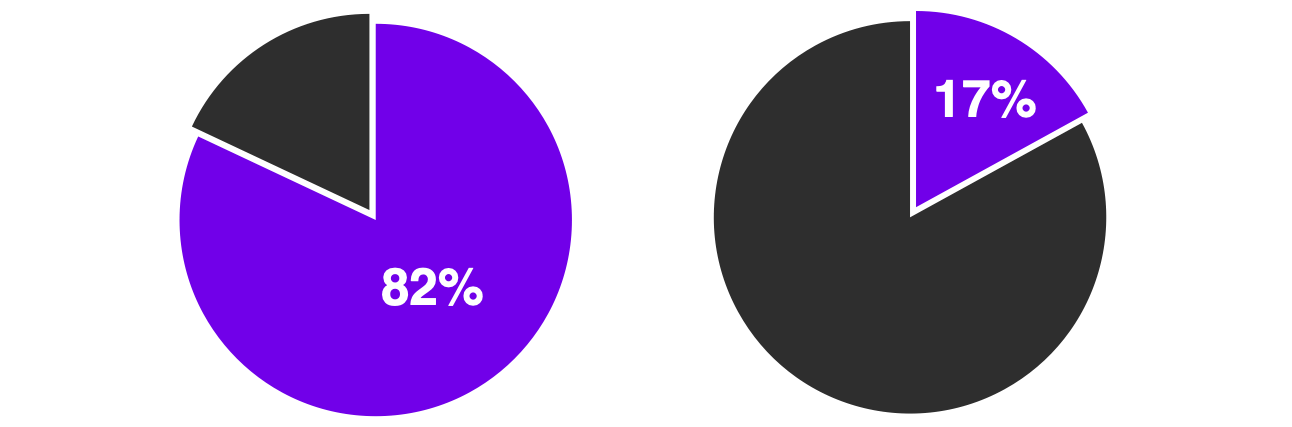
82% of Americans say people are struggling to tell what’s real from what’s fake. Just 17% see AI improving health care. That gap is a theme in the first results from our ongoing survey to understand Americans’ attitudes towards AI today, and how they’re evolving over time.
Every two weeks, working with NORC at the University of Chicago, we ask between 1,000 and 2,000 Americans about their feelings on AI, what they’re seeing in their communities and families, what they expect from the government, and how they picture different AI futures.
We publish our results at Americans On AI and talk about them here, in our newsletter.
Results
For the first edition of our newsletter, we’re giving an overview of what our biweekly survey tells us about Americans today:
Americans are more worried than excited about AI, and few feel they have any say over it. They see the harms around them, and few of the benefits. They want government to do more, and looking further out, many expect the technology to become powerful. And unlike almost everything else in American life, these feelings and experiences barely divide along party lines.
65% of Americans are more concerned than excited about AI, versus 24% who are more excited.
70% say AI is coming into their lives whether they want it or not. Just 15% feel they can shape how much AI is part of their lives.
On AI’s effects on children, the environment, and workers, by about 20 points, more people say the government is doing too little than too much.
77% think that “AI behaving in ways its developers didn’t intend” is already happening or likely in the future.
72% of women are concerned about AI versus 59% of men, with a similar gap between older and younger Americans.
Whether it’s their level of concern, their sense of control, or what they’re seeing around them, there’s little gap between Republicans and Democrats.
In future newsletters, we’ll zoom in on specific topics, themes, and trends.
Reactions
In discussing our first wave of results, Brendan Steinhauser from The Alliance for Secure AI shared this:
What I find really interesting about these early findings is that it comports very much with what we’ve been hearing on the ground. We spend a lot of time meeting with people across the country, from small informal gatherings, to big events like film festivals and political conventions. And regardless of whether we’re talking to someone from deep red Florida, or a big blue city, the level of concern is the same. People aren’t thinking about AI through a political lens like they do with most other issues.
Results from this wave were also picked up by The Hill and the Daily Caller.
Other News
A few items from the past two weeks that speak to what we found:
New poll from a progressive group finds AI companies viewed negatively. Data for Progress found that voters rank AI companies among the most negatively viewed actors in American society, in the same tier as cryptocurrency and sports-gambling firms. It fits our topline, where concern about AI runs well ahead of excitement.
AI was the top-cited reason for U.S. layoffs in June, a fourth straight month. The outplacement firm Challenger, Gray & Christmas reported that employers named AI behind more job cuts than any other factor in June. This is consistent with the 74% of Americans who told us AI is making job security worse.
AI safety report cards give no major company higher than a C+. The Future of Life Institute graded nine major AI companies across six safety and governance areas, and the top grade was a C+. This expert evaluation grounds our finding that most Americans expect AI to act in ways its developers don’t intend.
New federal bill would restrict AI chatbots aimed at children. Reps. Valerie Foushee and Greg Casar introduced the People-First Chatbot Act, which would bar training AI on minors’ chat logs and require chatbots to disclose that they are not human. We find most want more action here: by about 20 points, more say the government is doing too little than too much on AI and children.
States have passed more than 100 AI laws in 2026 so far. By the NYU Center on Technology Policy’s count, state AI laws this year are increasingly focused on child safety, consumer protection, and data centers, and increasingly draw support from both parties. Several also passed measures to shield households from the electricity costs of AI data centers.
Methodology
For this wave of the Americans on AI project, Athena Insights surveyed 1,814 US adults from June 25-30, 2026, using NORC at the University of Chicago’s AmeriSpeak panel, a probability-based panel designed to be representative of the U.S. household population. This included oversamples for certain subgroups to make comparisons more meaningful. Results are weighted to U.S. population benchmarks; the full-sample margin of error is +/- 3.4 percentage points. Full topline, crosstabs, methodology, data, and visualizations are available at Americans On AI.